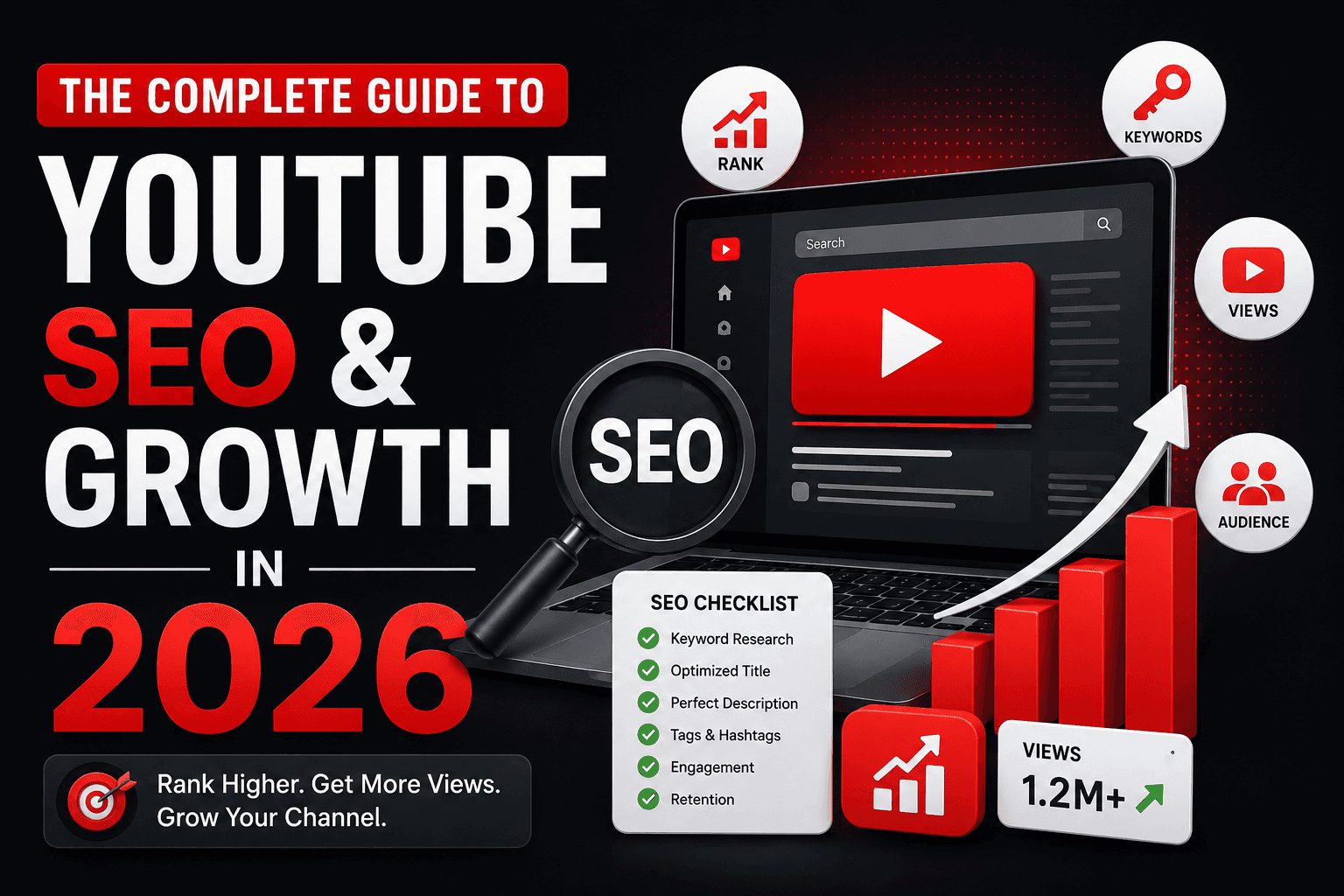
YouTube is the second-largest search engine on the planet, processing more than 3 billion searches every month. Yet most creators treat it like a social feed — publishing on vibes and hoping the algorithm picks them up. In 2026, that approach is a guaranteed flatline. This guide walks through the complete system we use at YTForge to help channels rank, get recommended, and compound their views month over month.
What Is YouTube SEO (And Why It Changed in 2026)
YouTube SEO is the practice of optimizing your videos so they surface in both YouTube search results and the recommendation system (Home, Suggested, Shorts feed). Search is intent-driven — someone types 'how to edit faster in DaVinci Resolve' and the algorithm returns the most relevant, well-engaged results. Recommendations are behavior-driven — YouTube shows your video to people whose watch history suggests they'd enjoy it.
The big shift in 2026 is that Google now surfaces YouTube videos directly inside AI Overviews for many how-to queries. That means a single well-optimized video can rank on YouTube, rank on Google, and appear inside Google's AI answer — three traffic sources from one piece of work. Optimizing for all three is the highest-leverage thing a creator can do this year.
Step 1: Keyword Research That Actually Converts
Every winning video starts with a keyword cluster — a primary search term plus 5–10 related phrases. The primary term goes in your title and the first line of your description; the related terms go into tags, spoken script, and on-screen text. This is how you signal relevance without keyword-stuffing.
Use YouTube's autocomplete (search a seed word and read the dropdown), the YouTube Trending tab, and a tool like YTForge's SEO Analyzer to pull search volume estimates and competition scores. You're looking for the sweet spot: decent search volume, low competition, and a clear viewer intent you can satisfy in full.
- Search intent first: is the viewer looking to learn, buy, or be entertained? Match your video's promise to that intent.
- Long-tail over broad: 'best budget mic for YouTube 2026' beats 'microphone' every time.
- Cluster, don't scatter: build 3–5 videos around one topic so YouTube sees you as an authority.
- Steal from competitors: pull the tags and chapters of the top 3 ranking videos and find the gaps they left.
Step 2: Titles, Descriptions, and Tags
Your title is the single highest-impact SEO element. The primary keyword should appear as close to the front as possible, ideally within the first 60 characters before truncation. Pair it with a curiosity or specificity hook — a number, a year, a contrarian angle — to lift click-through rate (CTR).
Descriptions are where most creators leave views on the table. The first 150 characters appear in search previews, so lead with a natural sentence containing your primary keyword. Then add a 2–3 paragraph summary, timestamps, and links. Tags carry less weight than they used to but still help disambiguate — use 8–15 highly relevant tags, not 30 generic ones.
- 1Front-load the primary keyword in the title.
- 2Keep titles under 60 characters to avoid truncation on mobile.
- 3Write a 2–3 sentence description with the keyword in the first line.
- 4Add 6–10 timestamps as chapters — Google indexes chapters as separate sections.
- 5Use 8–15 specific tags; skip broad terms like 'video' or 'youtube'.
Step 3: Thumbnails and Click-Through Rate
YouTube's algorithm weights CTR heavily because it's a direct signal of viewer interest. A video that gets clicked more often than its shelf-mates gets promoted to more shelves. Your thumbnail and title work as a pair — design them together, not separately.
High-CTR thumbnails in 2026 share a few traits: a single bold focal point, 3–4 words of text readable on a 2-inch mobile screen, high contrast, and an emotion on a face when relevant. Test two variants for the first 24 hours using YTForge's Thumbnail Preview tool to see how each renders across device sizes before committing.
If your thumbnail doesn't earn the click, your SEO doesn't matter. CTR is the gate to every other ranking signal.
Step 4: Retention and Engagement Signals
Once the click happens, watch time takes over as the dominant ranking factor. YouTube measures average percentage viewed (APV) and average view duration (AVD), and it compares your video's retention curve against similar videos. A flat or gently declining curve tells the algorithm viewers are satisfied; a cliff-drop at the 30-second mark tells it the title oversold.
Front-load value in the first 15 seconds — skip the slow intro and deliver the promise immediately. Use pattern interrupts every 30–45 seconds (a cut, a zoom, an on-screen graphic) to refresh attention. End with a payoff that pays off the title, not a generic 'like and subscribe'.
- Hook in 15 seconds: state the value viewers will get, then deliver it.
- Pattern interrupts every 30–45 seconds to fight attention drift.
- Aim for 50%+ APV on a 10-minute video — that's a strong satisfaction signal.
- Reply to early comments in the first hour; engagement breeds engagement.
- Ask one specific question in the video and pin a comment for replies.
Step 5: Shorts as a Growth Engine for Long-Form
Shorts are the fastest discovery surface on YouTube right now, and the algorithm has gotten better at converting Shorts viewers into long-form subscribers. The play is not to monetize Shorts directly — it's to use Shorts as a top-of-funnel hook that drives viewers to your deeper, search-optimized long-form videos.
For every long-form video, cut 2–3 Shorts from the best moments. End each Short with a clear link card to the full video. YouTube now carries a portion of Shorts viewers into the long-form watch session, which lifts watch time and signals topic authority back to search.
Step 6: Measure, Iterate, Double Down
Publishing is only half the job. After 7 days, open YouTube Studio and read three metrics: CTR (is the thumbnail earning clicks?), APV (is the content holding attention?), and traffic source split (are you winning search, browse, or suggested?). A video underperforming in search but overperforming in suggested tells you the title and thumbnail work but the SEO packaging doesn't — fix the description, tags, and chapters without re-uploading.
Use YTForge's Channel Analytics and SEO Analyzer to track keyword rankings over time and spot which videos are climbing. Double down on the topic clusters that are working: if a cluster is gaining search impressions, publish the next 3 videos in that cluster before moving on.
Putting It Together
YouTube SEO in 2026 is a system: research the right keywords, package them in a clickable title-and-thumbnail pair, satisfy the viewer with strong retention, reinforce relevance with description and chapters, and amplify with Shorts. Run the loop on every video, measure the results, and reinvest in what compounds. Do that consistently for 90 days and you'll see search impressions, click-through rate, and watch time all move in the same direction — up.
A repeatable weekly workflow
Block out one afternoon a week for the loop above. Monday: pull five keyword ideas from YouTube autocomplete and the Trending tab, score them with the SEO Analyzer, and lock the strongest. Tuesday: write the title and script around the chosen keyword, then generate three thumbnail variants. Wednesday: record and edit, front-loading the hook and placing a pattern interrupt every 30-45 seconds. Thursday: publish with a keyword-rich description, eight to fifteen specific tags, and six to ten chapter timestamps. Friday: cut two Shorts from the best moments and link them back to the long-form video. The following Monday, read CTR, APV, and traffic source split in YouTube Studio, then reinvest in the cluster that's climbing. Consistency beats intensity — a channel that runs this loop every week for a quarter will out-rank one that uploads sporadically with twice the production budget.
Common mistakes to avoid
- Keyword-stuffing titles and descriptions — YouTube's algorithm reads it as spam and suppresses reach.
- Treating tags as the main SEO lever — they are a secondary signal; title, thumbnail, and retention matter far more.
- Ignoring the first 15 seconds — a slow intro tanks average view duration before the algorithm ever gives you a real chance.
- Publishing one-off videos instead of clusters — YouTube rewards topical authority, so build 3-5 videos around each theme.
- Skipping the 7-day analytics review — without reading CTR and APV, you cannot tell which part of the loop to fix next.
- Forgetting Google AI Overviews — structure your description and chapters so Google can extract a clean answer for how-to queries.
Frequently asked questions
How long does YouTube SEO take to work?
Search-driven videos often climb for 30 to 90 days after publishing, because YouTube needs watch-time and CTR data from real viewers before it confidently ranks a video in search. Browse and Suggested traffic can land faster — sometimes within hours — but durable search rankings compound over weeks. Run the optimization loop on every video for a full quarter before judging whether the system is working.
Do tags still matter for YouTube SEO in 2026?
Tags are a secondary signal. They help YouTube disambiguate similar topics and group your video with the right recommendations, but they will not rescue a weak title or low-retention content. Use eight to fifteen specific, relevant tags — never stuff thirty generic ones — and lead with your primary keyword. The Tag Generator and Hashtag Generator inside YTForge handle this in seconds.
Can I rank an old video by updating its SEO?
Yes. Rewriting the title to front-load the keyword, expanding the description, adding chapter timestamps, and refreshing the thumbnail can revive a video that plateaued — YouTube re-evaluates the metadata and often re-tests the video in search and Suggested. You do not need to re-upload; edit in place inside YouTube Studio and watch the next 14 days of analytics.
Should I optimize Shorts differently from long-form?
Yes. Shorts are behavior-driven, not search-driven, so the priority shifts from keyword placement to the hook (frame one), pacing (2-3 second average shot length), and a looped ending that pushes rewatches. Use Shorts as a top-of-funnel hook that links to your search-optimized long-form video — that combination lifts both subscriber growth and watch time.
Want to skip the manual work? YTForge's AI tools handle keyword research, title generation, SEO audits, and channel analytics in one place — start free and let the data tell you what to make next.
AI titles, SEO audits, thumbnails, and channel analytics — all in one place.