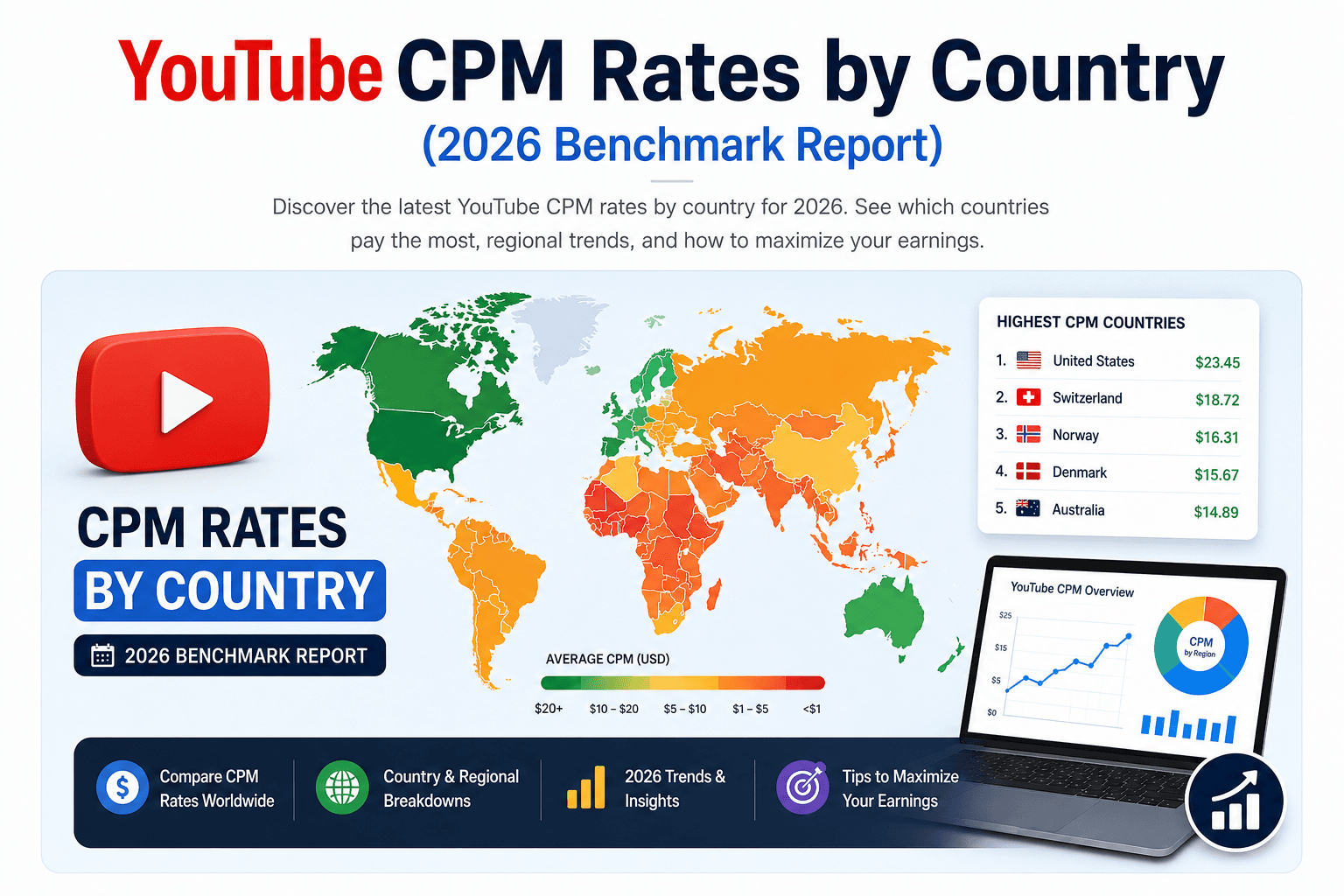
If you monetize on YouTube, two acronyms decide your paycheck: CPM (what advertisers pay per 1,000 ad impressions) and RPM (what you actually keep per 1,000 views after YouTube's cut and ad types). Both swing wildly by country — a single view from Norway can be worth 20x a view from India. This report benchmarks 2026 CPM and RPM by country, explains why the gaps exist, and shows how to raise your effective RPM regardless of where your audience lives.
CPM vs. RPM: Know the Difference First
CPM is the advertiser-side metric — the price an advertiser pays for every 1,000 ad impressions served on your videos. RPM is the creator-side metric — your total estimated earnings per 1,000 views after YouTube takes its 45% cut and after factoring in which ad types and impressions actually served. RPM is always lower than CPM, sometimes dramatically so, because not every view is monetized (some viewers use Premium, skip ads, or are in regions with low fill rates).
Rule of thumb: your RPM is roughly 40–55% of your blended CPM. If your channel averages a $12 CPM, expect an RPM around $5–6. The exact ratio depends on your audience geography, niche, and video length.
YouTube CPM & RPM Rates by Country (2026)
Below is our 2026 benchmark based on aggregated earnings data across mid-size monetized channels (50K–1M subscribers) in each region. Use these as a directional guide — your actual rates depend on niche, video length, and audience intent.
| Country / Region | Avg. CPM (USD) | Avg. RPM (USD) | Tier |
|---|---|---|---|
| Norway | $20–$32 | $8–$14 | S |
| United States | $15–$25 | $6–$11 | S |
| Australia | $14–$22 | $6–$10 | S |
| United Kingdom | $12–$20 | $5–$9 | S |
| Canada | $11–$18 | $5–$8 | A |
| Germany | $10–$17 | $4–$8 | A |
| Switzerland | $12–$20 | $5–$9 | A |
| Netherlands | $9–$15 | $4–$7 | A |
| New Zealand | $9–$14 | $4–$6 | A |
| Sweden | $8–$13 | $3–$6 | A |
| United Arab Emirates | $8–$12 | $3–$5 | B |
| Japan | $7–$11 | $3–$5 | B |
| Singapore | $7–$10 | $3–$5 | B |
| France | $6–$10 | $3–$4 | B |
| South Korea | $5–$9 | $2–$4 | B |
| Brazil | $3–$6 | $1–$2.5 | C |
| Mexico | $2–$5 | $0.8–$2 | C |
| Turkey | $2–$4 | $0.7–$1.5 | C |
| Philippines | $1.5–$3 | $0.5–$1.2 | C |
| Indonesia | $1.2–$2.8 | $0.4–$1 | C |
| Thailand | $1.5–$3 | $0.5–$1.2 | C |
| Vietnam | $1–$2.5 | $0.4–$1 | C |
| Egypt | $1–$2 | $0.3–$0.8 | C |
| Nigeria | $0.8–$1.8 | $0.3–$0.7 | C |
| India | $0.8–$2 | $0.2–$0.8 | C |
| Pakistan | $0.6–$1.5 | $0.2–$0.6 | C |
| Bangladesh | $0.5–$1.2 | $0.15–$0.5 | C |
Tier S markets — the Nordics, the US, UK, Australia — command the highest CPMs because advertisers there have large budgets and high willingness to pay for attention. Tier C markets (India, Pakistan, Bangladesh, much of Southeast Asia) have enormous viewership but thin advertiser demand, which compresses CPMs even as raw view counts explode.
Why the Country Gap Exists
CPM is fundamentally an auction — advertisers bid to show ads to your viewers. In countries with strong consumer purchasing power and mature ad markets, more advertisers bid and bid higher. In emerging markets, fewer advertisers compete and the average order value of the goods they sell is lower, so bids stay low.
This is why a gaming channel with 80% of its audience in India might earn the same from 1 million views as a finance channel with 80% US audience earns from 80,000 views. Audience geography isn't a vanity metric — it's the single biggest lever on your RPM.
CPM by Niche (Overlaid on Country)
Niche is the second-biggest lever. Advertisers pay more to reach viewers who are close to a purchase decision. Finance, SaaS, real estate, and insurance consistently top the CPM charts; entertainment, memes, and gaming sit at the bottom because the audience intent is recreational, not commercial.
| Niche | Avg. CPM (USD) | Avg. RPM (USD) |
|---|---|---|
| Finance / Investing | $15–$30 | $6–$12 |
| SaaS / B2B Tech | $12–$25 | $5–$10 |
| Real Estate | $10–$20 | $4–$8 |
| Insurance | $10–$18 | $4–$7 |
| Health & Fitness | $6–$12 | $2.5–$5 |
| Education / How-To | $5–$10 | $2–$4 |
| Lifestyle / Vlogs | $3–$7 | $1–$3 |
| Gaming | $2–$5 | $0.8–$2 |
| Entertainment / Memes | $1.5–$4 | $0.5–$1.5 |
How to Raise Your RPM in 2026
You can't move your existing audience to a new country, but you can shift the mix of who you attract going forward and how you monetize each view. These are the levers that move RPM without changing your content style.
- 1Target commercial-intent keywords: 'best,' 'review,' 'vs,' and 'how to buy' queries attract buyers, not just browsers.
- 2Make videos 8+ minutes long to unlock mid-roll ad slots — more ad impressions per view raise RPM.
- 3Pivot toward a higher-CPM niche over time: blend finance, business, or tech angles into your existing topic.
- 4Localize metadata: translate titles and descriptions into English to capture Tier S search traffic.
- 5Grow the YouTube Premium share of your audience — Premium pays a per-view rate independent of the ad auction.
- 6Diversify beyond AdSense: sponsorships, affiliate links, and your own products pay out at full RPM regardless of country.
Estimate Your Own Earnings
Take your monthly views, multiply by your blended RPM (in dollars per 1,000 views), and you have your AdSense ballpark. If you have 200,000 monthly views at a $3 RPM, that's roughly $600/month before taxes. A channel with the same views at a $7 RPM earns $1,400 — same work, more than double the payout, because the audience and niche differ.
To model your own scenarios with real numbers, use YTForge's free Earnings Calculator — drop in your views, country mix, and niche, and it projects monthly and yearly AdSense ranges instantly.
The Takeaway
Country and niche are the two forces that set your YouTube earning ceiling. A Tier C audience in a low-CPM niche will always struggle on AdSense alone; a Tier S audience in finance can earn a full-time income from a modest channel. The good news is that both are partially in your control — the keywords you target, the metadata you localize, and the niches you blend into your content all shift who watches next.
Stop treating CPM as a number you're handed. Treat it as a number you design for. Build for commercial intent, build for retention, build for the markets that pay — and your RPM will follow.
A practical 30-day RPM plan
Spend the first week auditing your current audience geography in YouTube Studio's Analytics > Audience tab. If more than 60% of your watch time comes from Tier C markets, your fastest RPM lift comes from redirecting future videos toward commercial-intent keywords and English-language metadata that captures Tier S search traffic. In week two, audit your niche against the table above and identify one adjacent, higher-CPM angle you can blend into your next three videos without alienating your existing audience. Week three: make every new video eight minutes or longer to unlock mid-roll ads, and add a single sponsorship or affiliate offer so each view earns beyond the ad auction. Week four: model the projected lift with the Earnings Calculator and confirm whether the new audience mix and niche shift moved RPM. Most channels see a 20-40% RPM improvement inside 60 days of running this plan.
Beyond AdSense: the full monetization stack
AdSense is the floor, not the ceiling. Once a video ranks and holds retention, layer revenue streams that pay out at full RPM regardless of geography: brand sponsorships (negotiated per-1,000-impression or flat fee), affiliate links in the pinned comment, digital products or courses sold from the description, and channel memberships. A channel earning $3 RPM on AdSense can triple effective earnings by adding one sponsorship per month and two evergreen affiliate links — the same views, paid multiple ways.
Frequently asked questions
What is a good YouTube CPM in 2026?
A blended CPM of $6-$10 is solid for a general-interest English-language channel. Finance, SaaS, and B2B-tech channels routinely clear $15-$25 CPM, while entertainment and gaming sit lower at $2-$5. What matters more than the headline number is your RPM — the share of that CPM you actually keep after YouTube's cut and unfilled impressions.
Why is my RPM so much lower than my CPM?
RPM is always lower than CPM because not every view is monetized — some viewers use YouTube Premium, skip ads, or sit in regions with low ad fill rates — and because YouTube keeps 45% of ad revenue. A typical channel keeps roughly 40-55% of its blended CPM as RPM. If the gap is wider than that, your audience skews toward Tier C markets or non-monetized impressions, and the levers above (commercial-intent keywords, longer videos, higher-CPM niches) are how you close it.
Does video length affect CPM?
Indirectly, yes. Videos under eight minutes cannot serve mid-roll ads, so they monetize only pre-roll and post-roll inventory. Videos eight minutes and longer unlock mid-rolls, which roughly double the ad impressions per view and lift both CPM and RPM. Length alone won't help if retention is poor — YouTube only serves mid-rolls where viewers keep watching — but it's the single easiest structural change to raise earnings.
How do Shorts CPMs compare to long-form?
Shorts RPMs are much lower than long-form — typically $0.05-$0.15 per 1,000 views — because Shorts ads are served between videos, not within them, and the inventory is priced for volume not intent. Treat Shorts as a discovery and subscriber-growth tool, not a direct revenue source; the long-form videos those Shorts viewers convert into will carry the real RPM.
AI titles, SEO audits, thumbnails, and channel analytics — all in one place.